Texas Counts 697 Kemp's Ridley Sea Turtle Nests, a New Record
CORPUS CHRISTI, Texas — November 9, 2026 announcement covering the 2026 nesting season.
Biologists and volunteers documented 697 Kemp's ridley sea turtle nests on the Texas coast in 2026, the U.S. Fish and Wildlife Service said on November 9. That is 55% more than the 449 nests found in 2025, which was itself the state's highest count since the recovery program began in 1978.
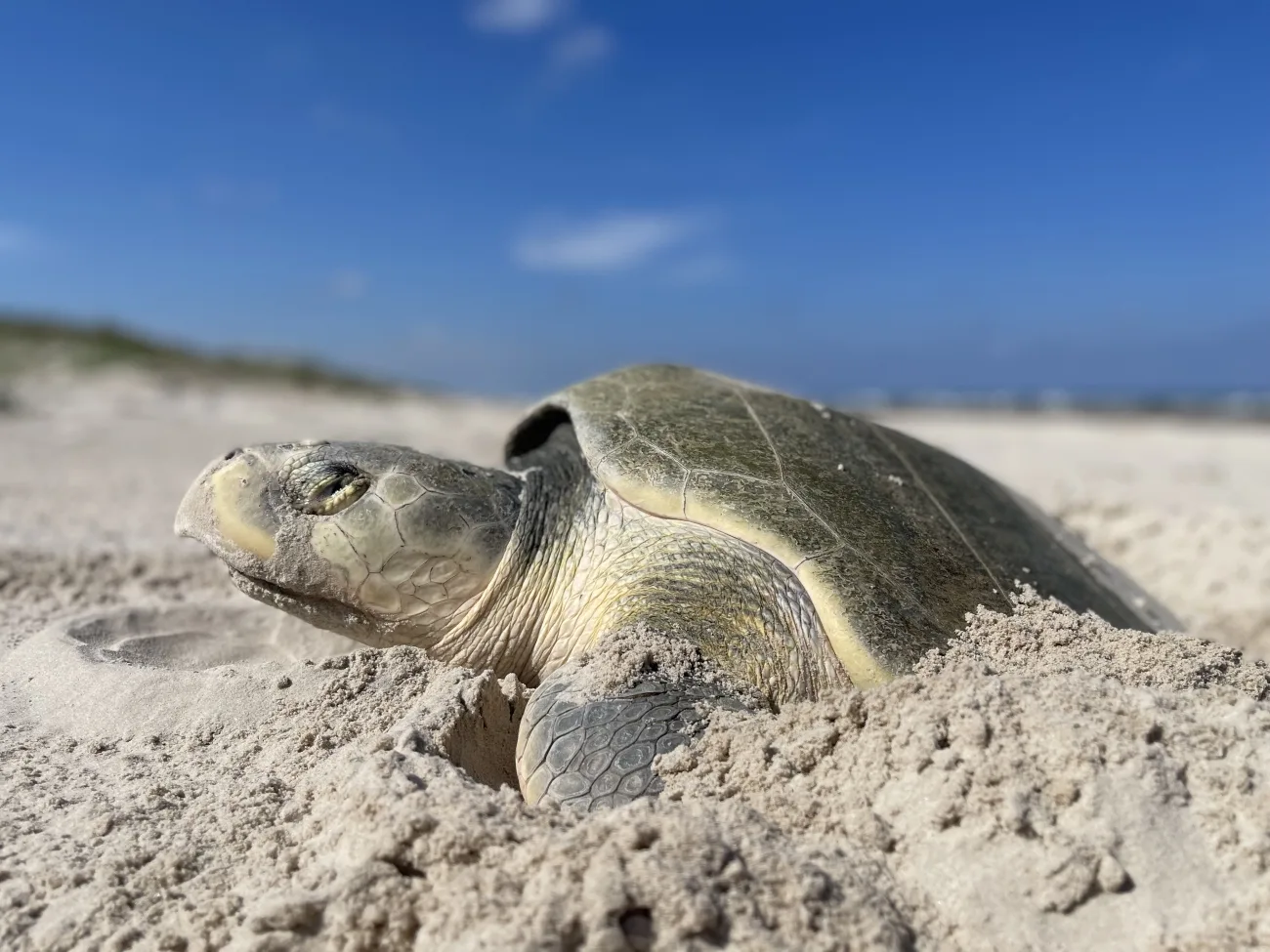
A Kemp's ridley sea turtle nesting on the Texas coast, photographed in 2023. Not an image of a specific 2026 nest. Photo: Cynthia Rubio / U.S. Fish and Wildlife Service, public domain.
The count comes from beach patrols run by trained staff and volunteers, plus reports from the public, according to the agency. The National Park Service, Texas Parks and Wildlife Department and other partners took part. Kemp's ridley is the smallest sea turtle and is widely described by federal agencies as the most endangered sea turtle in the world.
The jump is large by Texas standards. A 2025 Fish and Wildlife Service release listed 340 nests in 2024 and called 353 nests in 2017 the highest total recorded in Texas since 1978. In July 2026 the agency reported that Texas had already passed 650 nests, and that some turtles were showing early signs of arribada-like nesting, the mass, synchronized nesting events this species is known for.
The Texas colony did not appear on its own. Beginning in 1978, a joint U.S.–Mexico effort collected some eggs from Rancho Nuevo, Mexico, the species' main nesting beach, and incubated them at Padre Island National Seashore. Hatchlings were released on the beach so they might imprint on it, then recaptured, raised in Galveston, tagged and released. The first tagged turtles came back to nest at Padre Island in 1996, and the agency says this year's nesting females trace their lineage in part to those turtles.
"What began as a conservation emergency has become a remarkable success story," said Dr. Donna J. Shaver, who leads the park's Division of Sea Turtle Science and Recovery, in the release.
Beyond the Headlines
A strong Texas year is not the whole species
Texas is a secondary nesting area. NOAA Fisheries says about 95% of all Kemp's ridley nesting happens in Tamaulipas, Mexico, so the Texas record tells us a lot about the U.S. colony and much less about the global population. The November release does not give Mexico's 2026 numbers.
The longer history is a reason for caution. According to NOAA, nests fell to a low of 702 in 1985, representing fewer than 250 nesting females. Numbers then grew about 15% a year through 2009, but that climb stopped abruptly in 2010, and nesting has fluctuated since. Scientists have not settled why. NOAA lists bycatch in fishing gear as the biggest ongoing threat, along with beach driving, lighting, pollution and egg predators such as coyotes and raccoons. One record season is good news, not proof that recovery is secure. Population data for other coastal species can be thinner still: in Delaware Bay, researchers have questioned continued sand tiger shark collection without a formal population assessment.
How beachgoers and anglers can help right now
Nesting season runs roughly from March through September, so the most urgent issue on the Texas coast this time of year is different: cold. The National Park Service explains that when water drops below about 50°F, sea turtles can become "cold-stunned," too sluggish to swim, and may float or wash ashore. Most cold-stunned turtles in South Texas are juvenile green sea turtles, but any stranded sea turtle should be reported.
The number to call is the same year-round: 1-866-TURTLE-5 (1-866-887-8535). Federal and park guidance asks callers to note the turtle's location, size and condition, and to stay nearby until help arrives if they can. Anglers who accidentally hook a sea turtle are also asked to call so a trained responder can assess it. During nesting season, the agencies ask people to drive slowly on beaches and keep at least 100 feet from nesting turtles.
If you bring a dog to Padre Island National Seashore, the park requires a leash no longer than 6 feet, held at all times. Our guide to a safer first beach visit with a dog covers seawater, heat and shoreline hazards. Only permitted, trained staff and volunteers may handle sea turtles.
Sources & further reading
- U.S. Fish and Wildlife Service — Kemp's Ridley Sea Turtle Nests Increase Across Texas Beaches in 2026 (November 9, 2026): the 697-nest count and program history.
- U.S. Fish and Wildlife Service — Renewed Hope for Kemp's Ridley Sea Turtles (July 2026): mid-season count and arribada-like nesting.
- U.S. Fish and Wildlife Service — Sea Turtle Nesting Season Kicks Off on the Texas Coast (April 2025): 2017 and 2024 nest totals and reporting guidance.
- NOAA Fisheries — Kemp's Ridley Turtle species profile: global nesting, 1985 low, post-2010 fluctuations and threats.
- National Park Service — Cold Stunned Sea Turtles at Padre Island National Seashore.
- National Park Service — Sea Turtle Stranding and Salvage Network: how to report a stranded sea turtle.