Mistaken for Vipers, 19 Legless Lizards Are Rescued From a Water Meter Pit in Poland
SILESIA, Poland — Rescue reported November 12, 2026, by the Leśne Pogotowie wildlife center; the exact date of the call-out was not given.
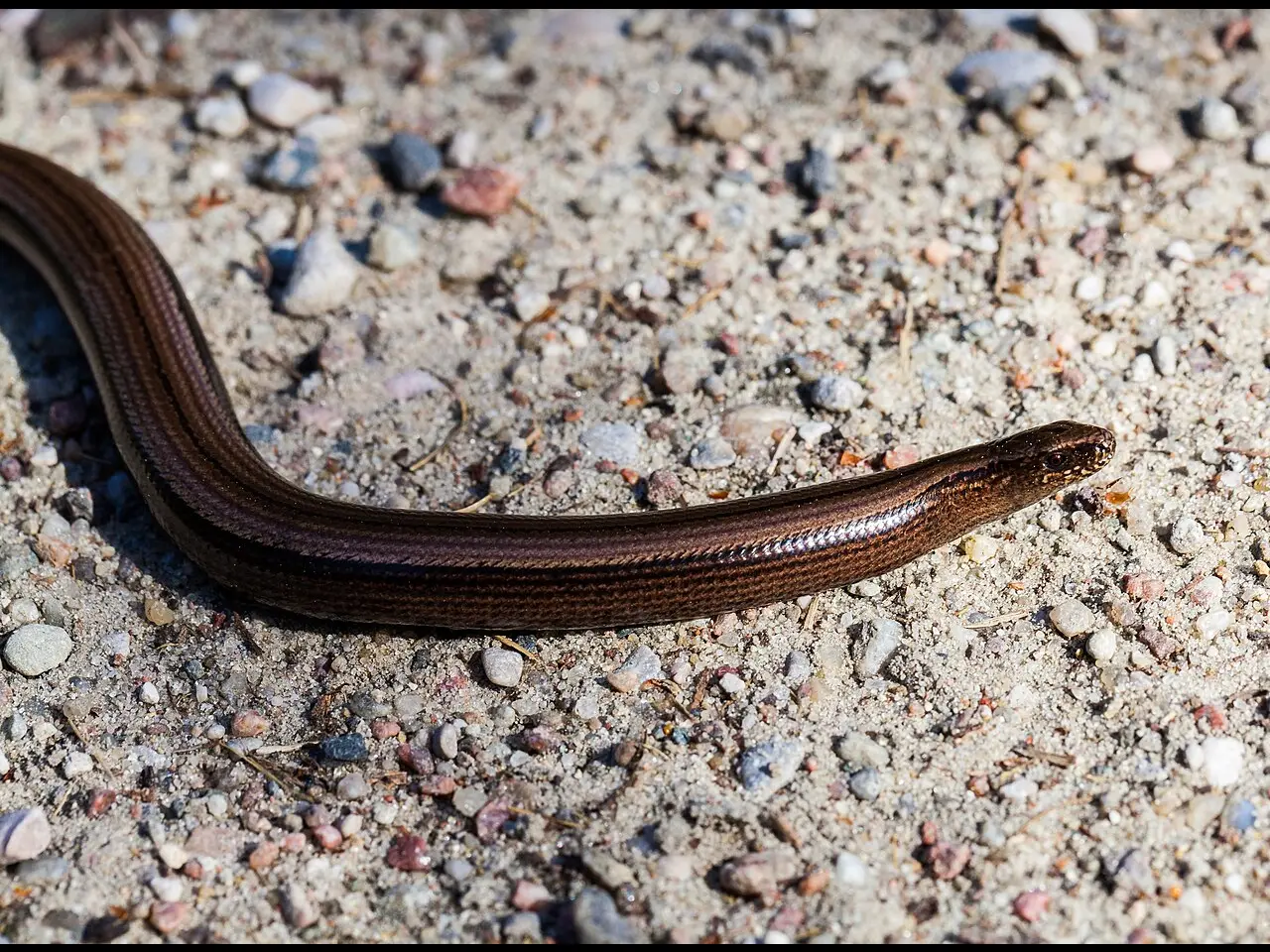
A slow worm (Anguis fragilis) photographed on Poland's Hel Peninsula in 2013. This is not one of the rescued animals. Photo: Diego Delso / Wikimedia Commons, CC BY-SA 3.0.
A worker who opened a water meter pit in southern Poland to swap the meter found 19 animals tangled at the bottom and froze, convinced they were vipers. They were slow worms, harmless legless lizards, and a wildlife rescue team took all 19 to spend the winter in safe conditions.
The call went to Leśne Pogotowie (Polish for "Forest Emergency"), a wildlife rehabilitation center in Mikołów-Kamionka, in the Silesia region. Forester Jacek Wąsiński founded it in 1993. The center described the rescue in a social media post, which Polish outlets including Interia, RMF24, Polsat News and TVN24 reported from November 12 to 14. The reports do not name the town where the pit was or say exactly when the team went out.
According to the center, the slow worms had probably picked the deep concrete pit as a winter shelter. It was cool and damp and kept out the worst of the frost. The catch was the walls: smooth and vertical. The lizards could get down but had no way to climb back out. "The pit would have become their grave," the center wrote, as quoted by Polsat News.
The property owner gets much of the credit. Instead of chasing the animals off or tossing them out, the owner called for help and waited for the team. "Despite their fears," the center wrote in the post quoted by TVN24, the owner "called for help and waited for us."
Releasing the lizards on the spot was not an option. At this time of year, slow worms should be deep in their winter dormancy. The center said that putting them out in the garden at current temperatures would have meant freezing, because they would not have had time to find or dig a new safe shelter. They are now at the center, where staff are keeping them in stable winter conditions, and they will go back to the wild on warm spring days.
Beyond the Headlines
Why a slow worm is not a snake
The mix-up is common. Slow worms lost their legs over the course of evolution, but unlike snakes they have movable eyelids and ear openings, and like many lizards they can drop part of the tail to escape a predator. They are not venomous. In gardens they hunt slugs, snails and other small invertebrates, which is why the Polish center called them useful garden residents. If you are curious about the other side of that menu, our profile of the brown garden snail explains how a common garden snail feeds and why it can go quiet in dry or cold weather.
Wąsiński also noted that Poland has two slow worm species, not one. Genetic studies identified the eastern slow worm (Anguis colchica), found mainly in the country's southeast, including the Bieszczady Mountains and the Carpathians. It differs from the common slow worm in its scale pattern, and many males have blue spots on the back. Slow worms are protected species in Poland, as TVN24 noted.
Slow worms do not live in the United States, but America has legless lizards of its own. North Carolina's wildlife agency describes the eastern glass lizard, which can reach 43 inches, as snake-like but with movable eyelids and visible ear openings. Its tail breaks off easily, which is where the "glass" name comes from. In the Big South Fork area of Tennessee and Kentucky, the National Park Service notes, the slender glass lizard is listed as "deemed in need of management" in Tennessee and threatened in Kentucky. Reptile rescues that make the news usually involve bigger animals, like the record Kemp's ridley sea turtle nesting season in Texas, but small, overlooked species run into trouble around homes too.
The American version of the trap: window wells
In the U.S., the closest equivalent to that meter pit is the open basement window well. The Illinois Department of Natural Resources' Wildlife Illinois site warns that wells without secure covers trap snakes, toads, salamanders, turtles and young mammals that fall in and cannot climb out. It suggests lifting small animals out by hand or sweeping them gently into a bucket, propping a rough board at an angle so larger animals can climb out, and fitting a cover flush to the wall. Wisconsin's DNR gives similar advice for frogs, toads and salamanders: cover window wells or add a short untreated board as a ramp.
That advice is written with active animals in mind. The Polish case shows the winter exception: a cold, dormant reptile set loose in freezing weather may not find new shelter in time. If you find one in winter, or an animal that is hurt, call a wildlife rehabilitator or your state wildlife agency before you move it.
Sources & further reading
- Euronews — Rescatan a 19 lagartos sin patas atrapados en una arqueta en Polonia (November 15, 2026), the report that brought the story to us, in Spanish.
- Interia Zielona — Earliest report found (November 12, 2026), with photos credited to the State Forests and Leśne Pogotowie, in Polish.
- Polsat News — Quotes from the center's post on the pit, the owner's response and the decision not to release the lizards (November 13, 2026), in Polish.
- TVN24 — Jacek Wąsiński's account, the two Polish slow worm species and their protected status (November 14, 2026), in Polish.
- RMF24 — Report on the rescue and on Leśne Pogotowie, active since 1993 (November 13, 2026), in Polish.
- Amphibian and Reptile Conservation Trust — Slow-worm: identification, diet and legal protection in Great Britain.
- North Carolina Wildlife Resources Commission — Eastern Glass Lizard species profile.
- National Park Service — Big South Fork National River and Recreation Area: slender glass lizard and its state status.
- Wildlife Illinois (Illinois Department of Natural Resources) — Animal in My Window Well.
- Wisconsin Department of Natural Resources — Ways to help Wisconsin's frogs, toads and salamanders, including window well ramps.