Coyotes Are Here to Stay on the Outer Banks, DNA Study Finds
RALEIGH, North Carolina — November 10, 2026 study, based on surveys from 2024 and 2025.
Somewhere between 45 and 61 coyotes live on North Carolina's Outer Banks at any given time, and more than a decade of lethal removal has not pushed them off the islands, according to a peer-reviewed study published November 10 in the Journal of Wildlife Management. The NC State University researchers behind it say the animals should now be treated as a permanent part of the barrier island ecosystem.
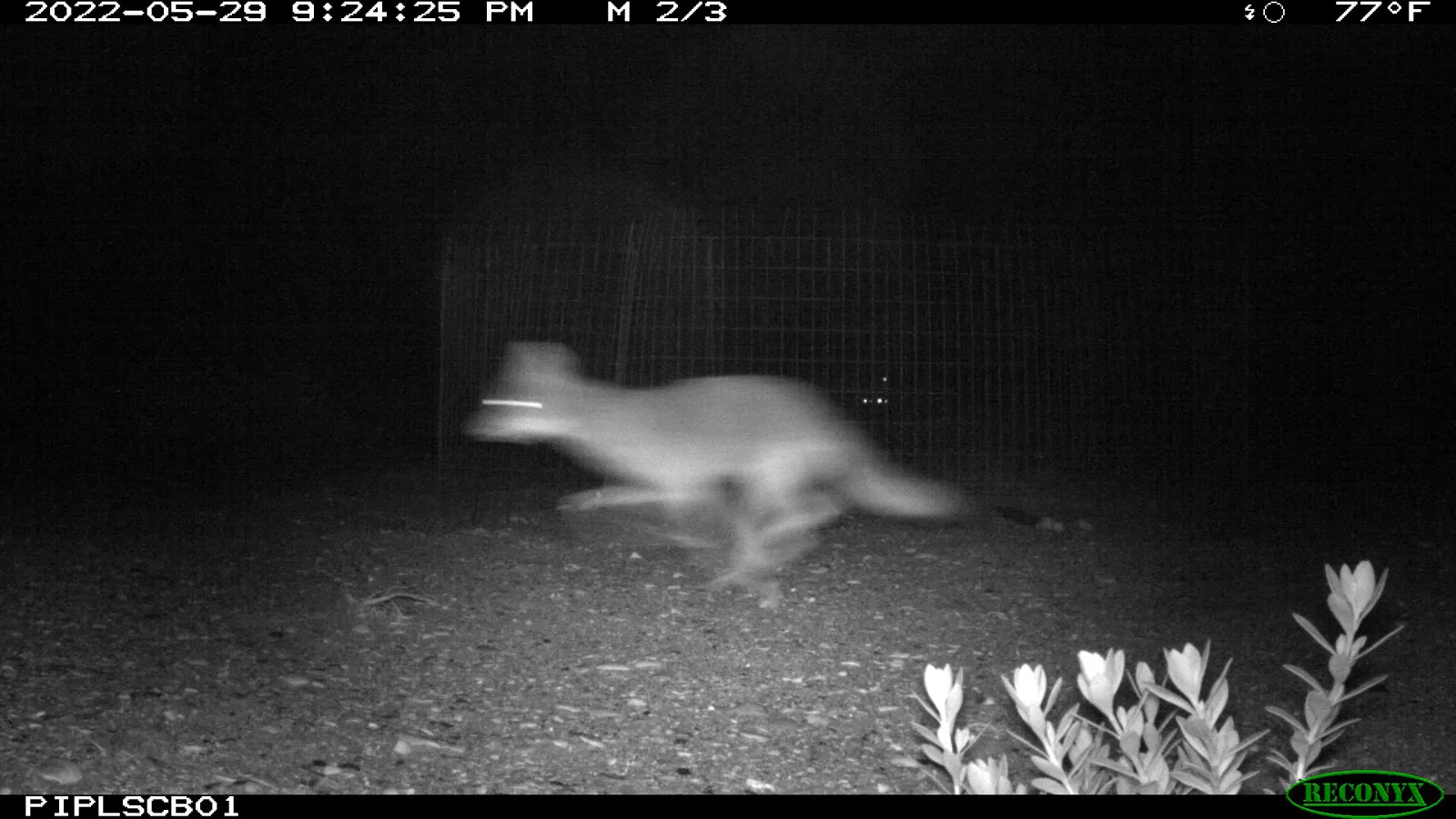
A trail camera catches a coyote running past a wire exclosure built to protect a piping plover nest at Cape Lookout National Seashore, May 29, 2022. Photo: National Park Service, Cape Lookout National Seashore (U.S. government work, public domain).
It is the first peer-reviewed estimate of coyote numbers on any barrier island, according to NC State. Over three survey seasons, in winter 2024, summer 2024 and winter 2025, the team collected 383 coyote scat samples on seven islands: Bodie, Pea, Hatteras, Ocracoke, North Core, South Core and Shackleford Banks. DNA from 247 of those samples identified 62 individual coyotes, 20 males and 42 females. The researchers then used repeat detections of the same animals to estimate how many were present each season.
Coyotes are newcomers here. The study says they colonized the Outer Banks beginning in the late 2000s and prey on protected shorebird and sea turtle nests. Federal agencies responded with lethal removal, starting at Cape Hatteras National Seashore in 2009, expanding to Cape Lookout National Seashore in 2017 and to Pea Island National Wildlife Refuge in 2023. The paper counts more than 160 coyotes removed; NC State's announcement puts the 2009–2025 total above 170.
The removals have not stuck. The National Park Service took 14 coyotes from Bodie and Hatteras islands in 2024, yet the researchers kept detecting coyotes on both islands all year, with new animals replacing many of those that disappeared. In recent years removals took out roughly a third of the population across the whole system, the study found, and in some places in a single year they matched or exceeded the island's entire estimated population.
"Coyotes are here to stay on the Outer Banks," lead author Daniel Sossover, a research associate at NC State and the North Carolina Museum of Natural Sciences, said in the university's announcement.
The genetics help explain why. Coyote density dropped as islands got farther from the mainland: Bodie Island, which is connected to the mainland, had the most, and North Core Banks the fewest, followed by Ocracoke. The team found four genetic groups, each with low diversity and many close relatives, a pattern consistent with a few founders from the mainland whose families now make up most of each island's population. Some genetic links to mainland coyotes suggest that occasional newcomers still arrive.
Beyond the Headlines
Swimming coyotes and the nests at stake
A companion National Park Service report, built on the same research with USDA Wildlife Services, adds detail that a population count cannot. GPS collars fitted on a few coyotes at Cape Lookout showed animals repeatedly swimming between islands, often at night and near low tide, and one coyote covered 33 miles in 12 hours. In one area, coyote numbers returned to about the same level a couple of months after nearly a dozen were removed.
The same report found that most coyotes used beaches without appearing to target nests, but roughly a third may specialize in them. That matters because the beaches are nesting grounds for federally threatened piping plovers and loggerhead sea turtles, along with American oystercatchers, least terns and black skimmers. Coyotes are a known threat to turtle eggs elsewhere too: NOAA Fisheries lists them among the egg predators of Kemp's ridley sea turtles, whose Texas nests reached a record 697 this year.
Instead of trying to wipe coyotes out, the parks say they are shifting to targeted steps during nesting season: removing specific problem animals near nests, adding more predator exclosures like the one in the photo above, and testing fladry, a line of flags that works as a visual barrier. Fladry cut one frequent visitor's crossings into a protected area by about 83%, the park service reported, but results have been mixed because coyotes can get used to it or find a way around.
What it means if you visit with a dog
For the many people who bring pets to the Outer Banks, the takeaway from Cape Lookout National Seashore's guidance is simple: assume coyotes may be nearby, day or night, though they are most active in the evening and early morning. The park says coyotes may see outdoor cats and small unleashed dogs as prey, and may confront larger dogs as territorial threats, especially during the mating and pup season from January through June. Its advice is to keep pets leashed, pack out all trash and food, never feed a coyote, and scare off one that comes close by making noise or tossing a small object toward it. Attacks on people are extremely rare, the park notes.
Before a trip, it also helps to check each beach's own pet rules, which can change by season. Our guide to a safer first beach visit with a dog covers leash rules, heat, seawater and shoreline hazards.
Sources & further reading
- NC State University — Coyotes Are Likely a Permanent Fixture on the Outer Banks, Study Finds (November 10, 2026), with the study abstract.
- Journal of Wildlife Management — Coyote density, demography, and genetic structure across North Carolina's barrier islands (Sossover, Kays, Kierepka and Hostetter, 2026).
- National Park Service — Coyotes on the Move: What a New Study Means for Protecting Coastal Wildlife.
- Cape Lookout National Seashore — Coyotes on the Outer Banks: behavior, pets and how to prevent conflicts.